Julian Calendar 2026
The Julian calendar is a calendar system based on the Julian Date (JD), which is a continuous count of days beginning at noon on January 1, 4713 BCE, in the proleptic Julian calendar. It was introduced by Julius Caesar on 1 January 45 BC as part of the reform of the Roman calendar and later became widely used across Europe. The Julian calendar has two types of years, a typical year with 365 days and a leap year with 366 days. Although it is no longer used as a civil calendar in most places, the Julian calendar is still used today for religious observances in certain communities and for scientific purposes. This collection also includes free printable Julian calendar references for easy use and planning.
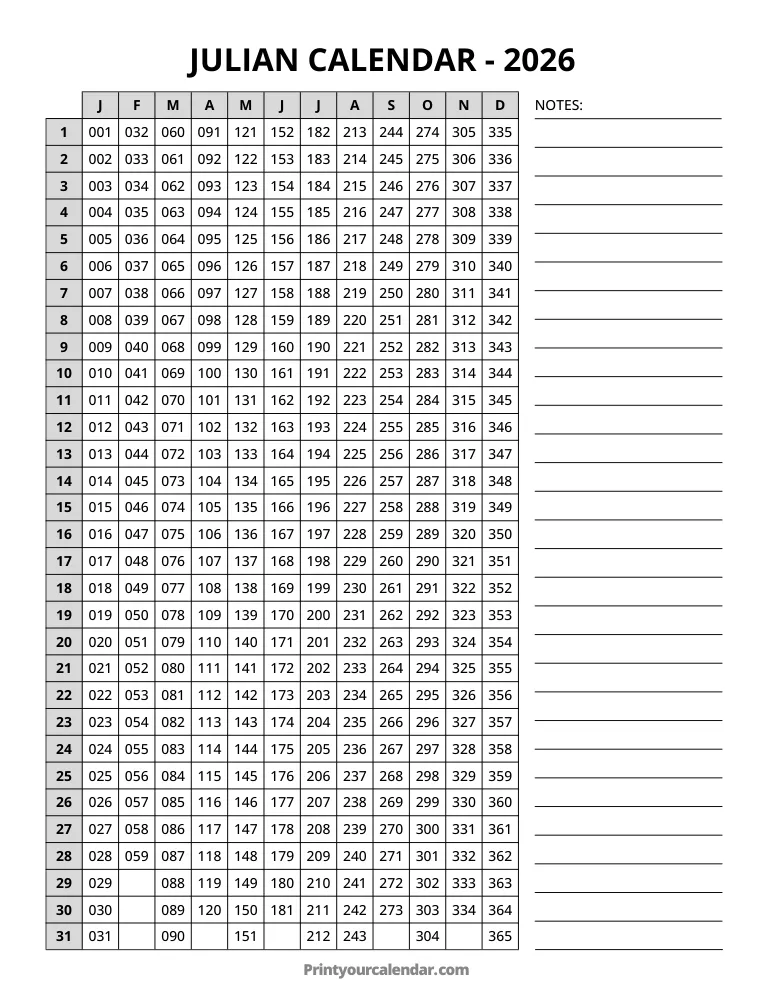
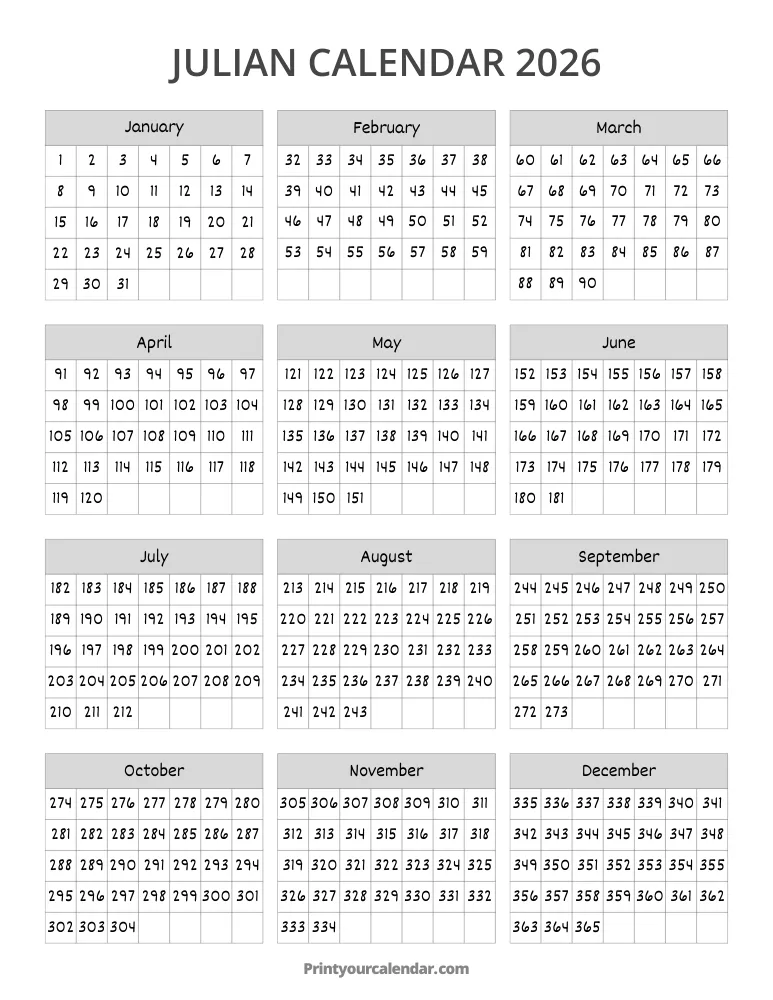
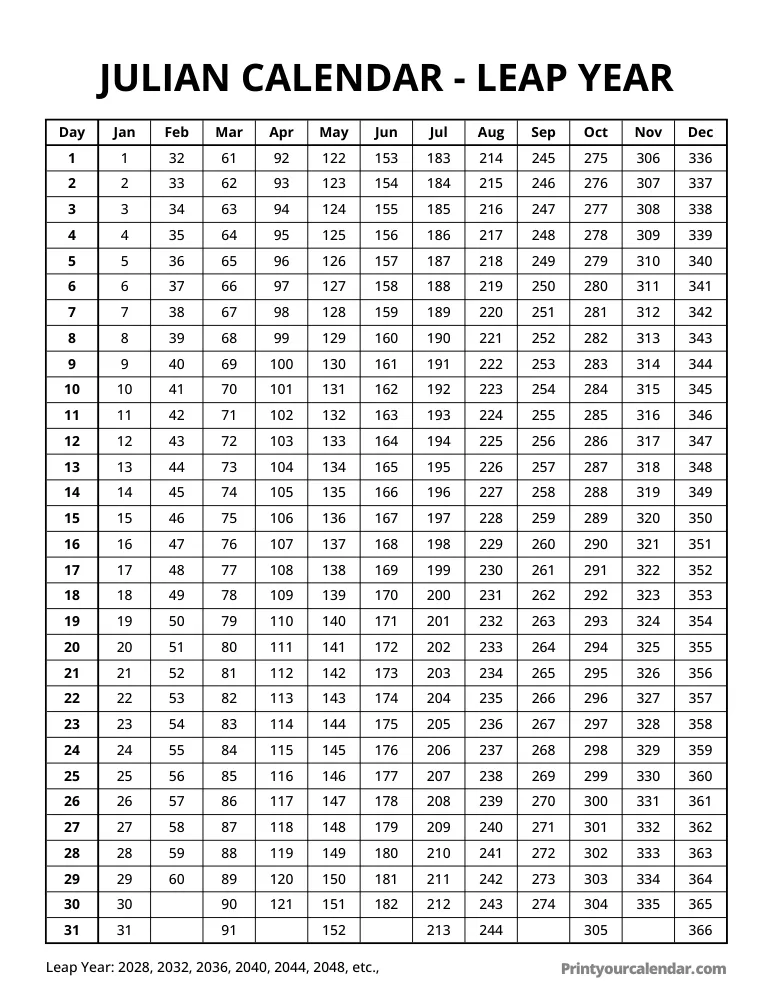
In many business and industries such as manufacturing, food, pharma, logistics, and the military, a Julian based system is commonly used for date tracking. These fields rely on an ordinal date format known as a Julian code. It appears in a 5 digit or 7 digit format such as YYDDD or YYYYDDD. The last 3 digit DDD represents the day of the year, with a range from 001 to 365, or 366 in a leap year. For example, the 32nd day of the year 2026 would be written as 26032 in the YYDDD format.
Printable 2026 Julian Calendars
In this section, you will find a variety of free printable Julian Calendar 2026 templates that help you track the whole year at a glance and see where you are in the year and how many days are left or have passed.
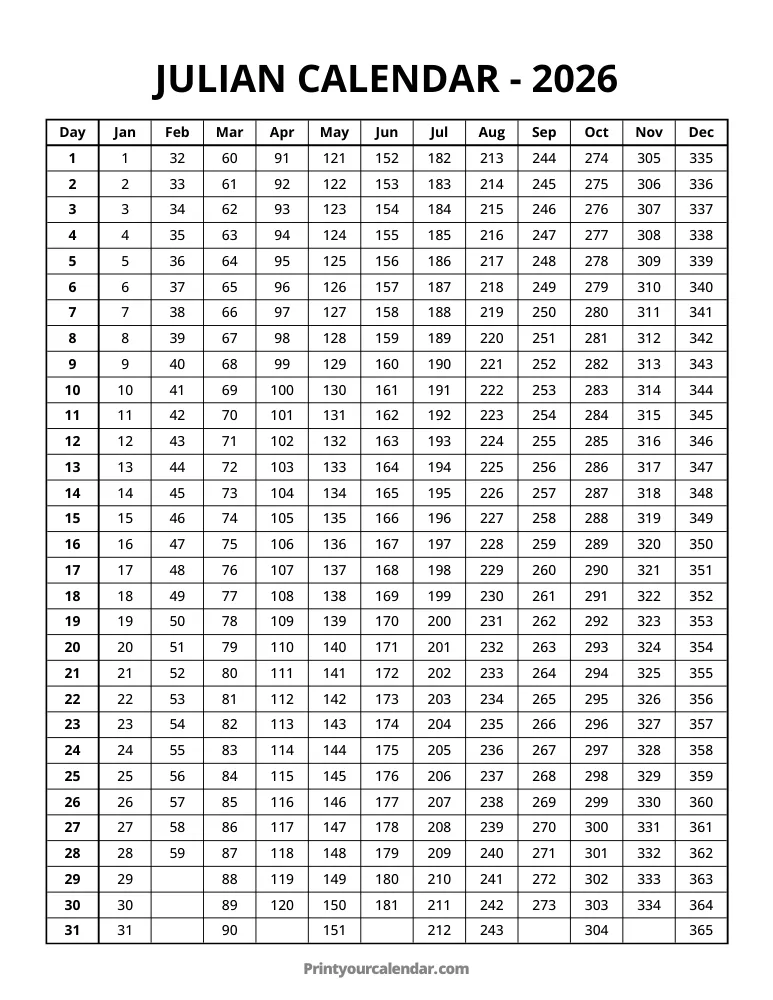
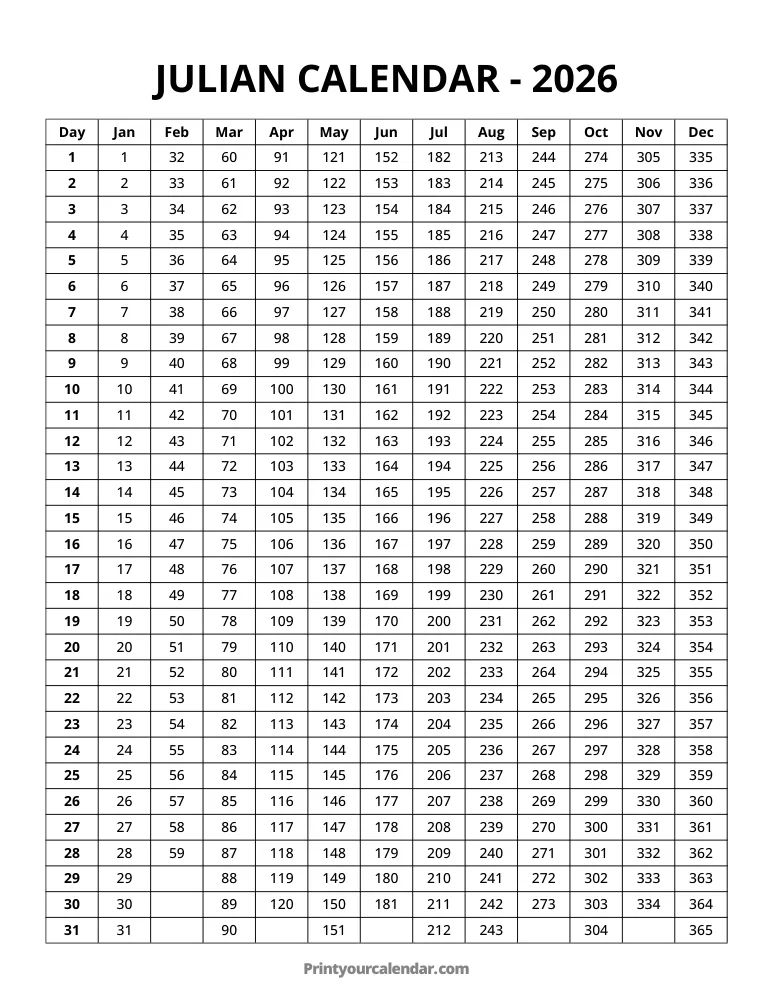
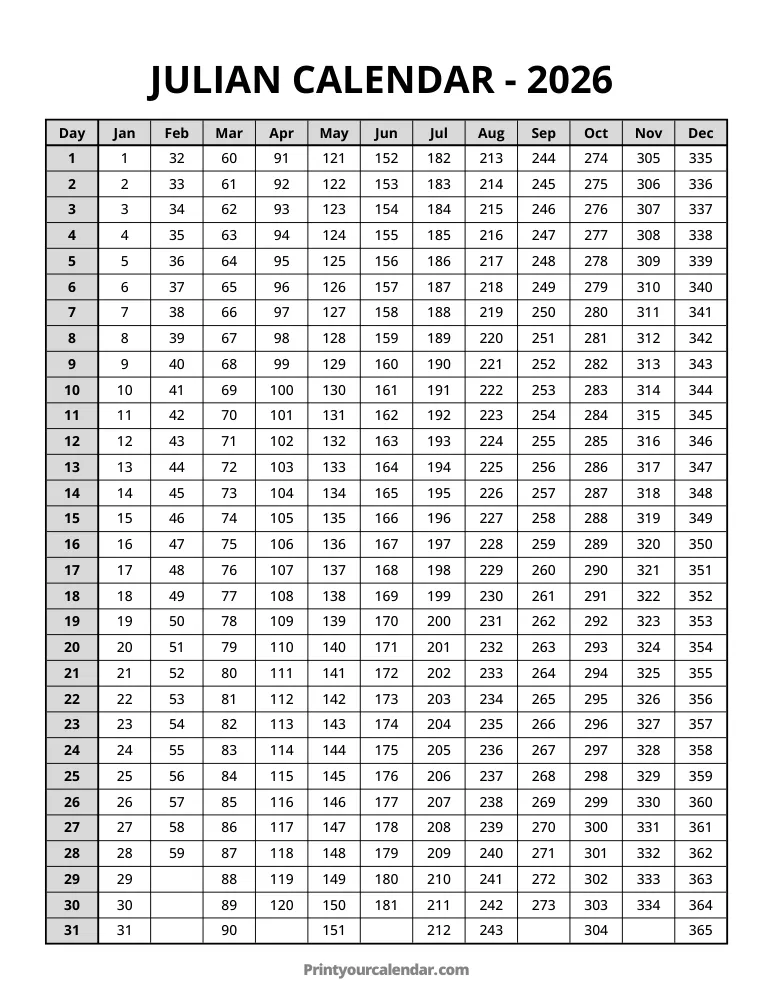
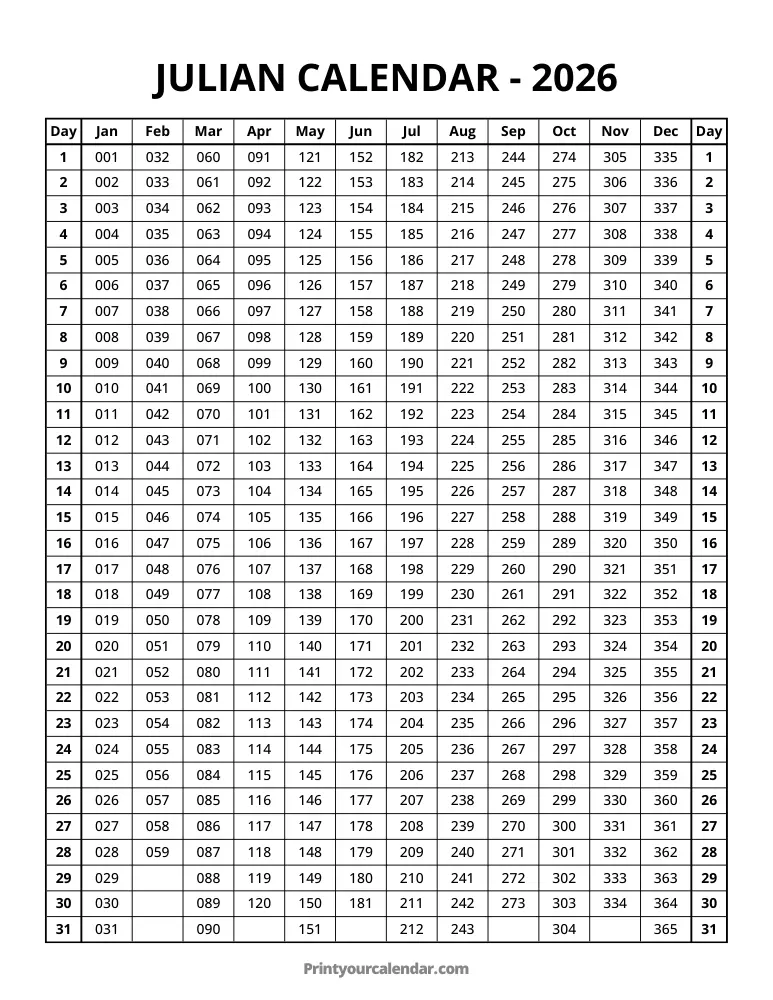
How to Calculate Julian Date?
The Julian Date system is used to count days in a continuous sequence where each day starts at noon instead of midnight. A Julian Day runs from noon to the next noon, and the total count increases by one at each noon.
When calculating a Julian Day, decimal values are used to show the portion of the day that has passed since noon. This decimal part helps represent the exact time within the day.
Here is an example of how the decimal values work:
6 PM equals 0.25
12 midnight equals 0.50
6 AM equals 0.75
12 noon equals 1
This method allows accurate tracking of time within a single Julian Day and makes it easier to compare dates without confusion.
Julian calendar vs Gregorian calendar
The Julian calendar was introduced by Julius Caesar on 1 January 45 BC, while the Gregorian calendar was introduced by Pope Gregory XIII in 1582. Today, the Julian calendar is still used for religious and scientific purposes, while the Gregorian calendar is used for most civil calendars around the world.
The Julian calendar uses a simple leap year rule where every four years is a leap year, resulting in an average year length of 365.25 days. The Gregorian calendar also uses a four year cycle, but years divisible by 100 are not leap years unless they are also divisible by 400. This adjustment results in an average year length of 365.2425 days, making the Gregorian calendar more accurate over long periods.

El equipo de Printyourcalendar es un pequeño grupo apasionado que ama crear calendarios imprimibles elegantes y útiles. Combinamos creatividad con investigación para diseñar calendarios imprimibles hermosos y funcionales, asegurándonos de que haya uno perfecto para ti. Ofrecemos una variedad de calendarios gratuitos, incluyendo calendarios mensuales, calendarios anuales e incluso plantillas en blanco. Lee más